
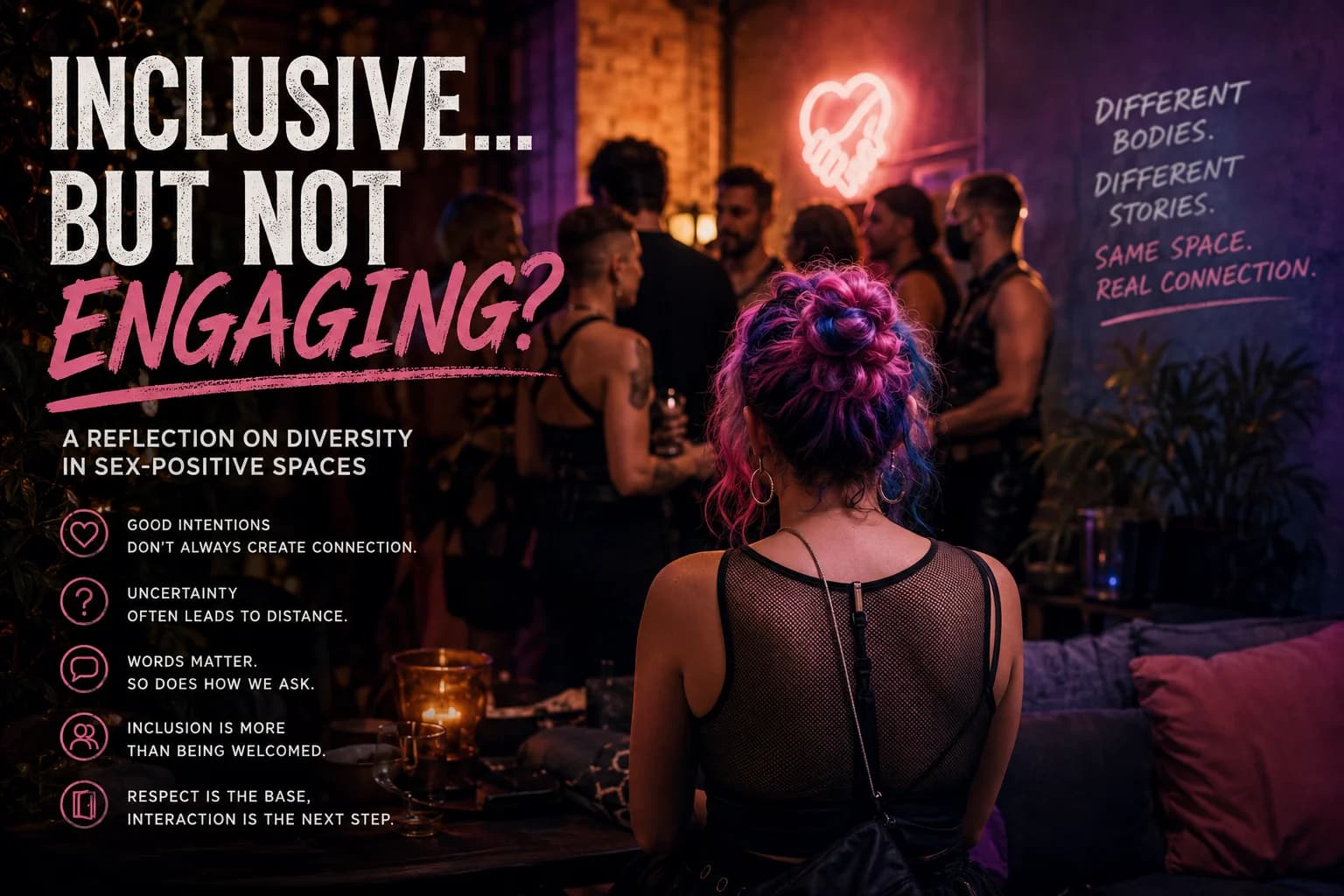
A Reflection on Diversity in Sex-Positive Spaces
As a community grows, it naturally becomes more diverse.
More backgrounds.
More identities.
More ways of being.
More ways of expressing.
And with that diversity comes something interesting.
Not a problem, but a shift in dynamics.
Moments where good intentions meet uncertainty.
Where respect turns into hesitation.
Where inclusion is present, but interaction becomes more careful, sometimes almost neutral.
Respect Is There. Something Else Is Missing.
In sex-positive spaces, people are often kind, open, and respectful.
They talk.
They listen.
They include.
But sometimes, something feels slightly incomplete.
It is not the absence of interaction, politeness, or even warmth.
More like a missing step.
People engage, but don’t move forward.
They connect, but don’t explore the interaction further.
And that creates a subtle space:
👉 visible, but not fully engaged
👉 included, but approached with distance
When Good Intentions Create Distance
Most of the time, this does not come from bad intentions.
Quite the opposite.
People may think:
- “I don’t want to make them uncomfortable.”
- “I don’t want to cross a line.”
- “I don’t want to look inappropriate.”
- “I’m not sure how to approach this.”
So they choose the safest option:
They stay neutral.
And this is where something shifts.
In trying to be respectful, people sometimes remove spontaneity, curiosity, and openness from the interaction.
What remains is correct.
But also more distant.
The Over-Correction
Many of us come from environments where boundaries are often ignored or pushed too far.
So when entering a sex-positive space, there is a natural correction:
From too much → to very little
From intrusive → to overly careful
And sometimes, that correction goes so far that the person in front of us is no longer approached as a full individual, but as someone we need to navigate cautiously.
That shift is rarely explicit.
But it is often felt.
The Language Trap
It also shows up in the way people speak.
Some sentences are meant as compliments, but land differently:
- “You’re surprisingly feminine.”
- “I didn’t expect that.”
- “You’re actually very attractive.”
- “I did not want to look bad by hitting on you.”
The intention may be positive.
But the effect is different.
Instead of creating connection, these phrases highlight difference and reinforce a sense of distance.
Uncertainty Slows Everything Down
There is a simple mechanism underneath all of this:
Uncertainty leads to hesitation.
Hesitation leads to inaction.
Not because there is no interest.
But because there is no clarity on how to act.
So people default to neutrality.
And neutrality, in a space built on expression and interaction, can feel like absence or exclusion.
Inclusion vs Interaction
Inclusion is often understood as:
- being respectful
- being welcoming
- making space
But in sex-positive environments, there is another layer:
👉 being open to interaction, curiosity, and connection
And those are not the same thing.
You can include someone perfectly…
and still keep the interaction at a safe distance.
You can be respectful…
and never move beyond it.
Of course, this reflection goes beyond simple attraction or curiosity. Those remain personal matters and a fundamental prerequisite for any deeper interaction.
What Helps Without Overcomplicating It
There is no perfect formula. But a few simple shifts can help:
- Ask instead of assuming
A simple question removes more uncertainty than silence. - Do not over-focus on difference
The more you center it, the more it defines the interaction. - Let feedback guide you
People show, verbally or not, what feels comfortable. - Stay human
You do not need the perfect approach. Presence matters more. - Allow space for interaction, not just correctness
Respect is the base, not the final step.
A Pattern Worth Noticing
This is not about saying people are doing something wrong.
It is about noticing something that might already be happening.
A space can be inclusive, safe, respectful, and shameless…
and still feel slightly disconnected in certain interactions.
Not exclusion.
Not rejection.
Just a kind of distance that no one explicitly chose.
Open Questions
So maybe the reflection is not about finding the “right” way to behave.
But about asking ourselves a few honest questions:
- Do we sometimes hold back out of respect… or out of uncertainty?
- Is being careful always inclusive?
- What does a natural, respectful interaction look like in a diverse space?
- And are we as open as we think, when things fall outside what we are used to?
There are no clear answers.
But noticing these patterns might already be a good place to start.