
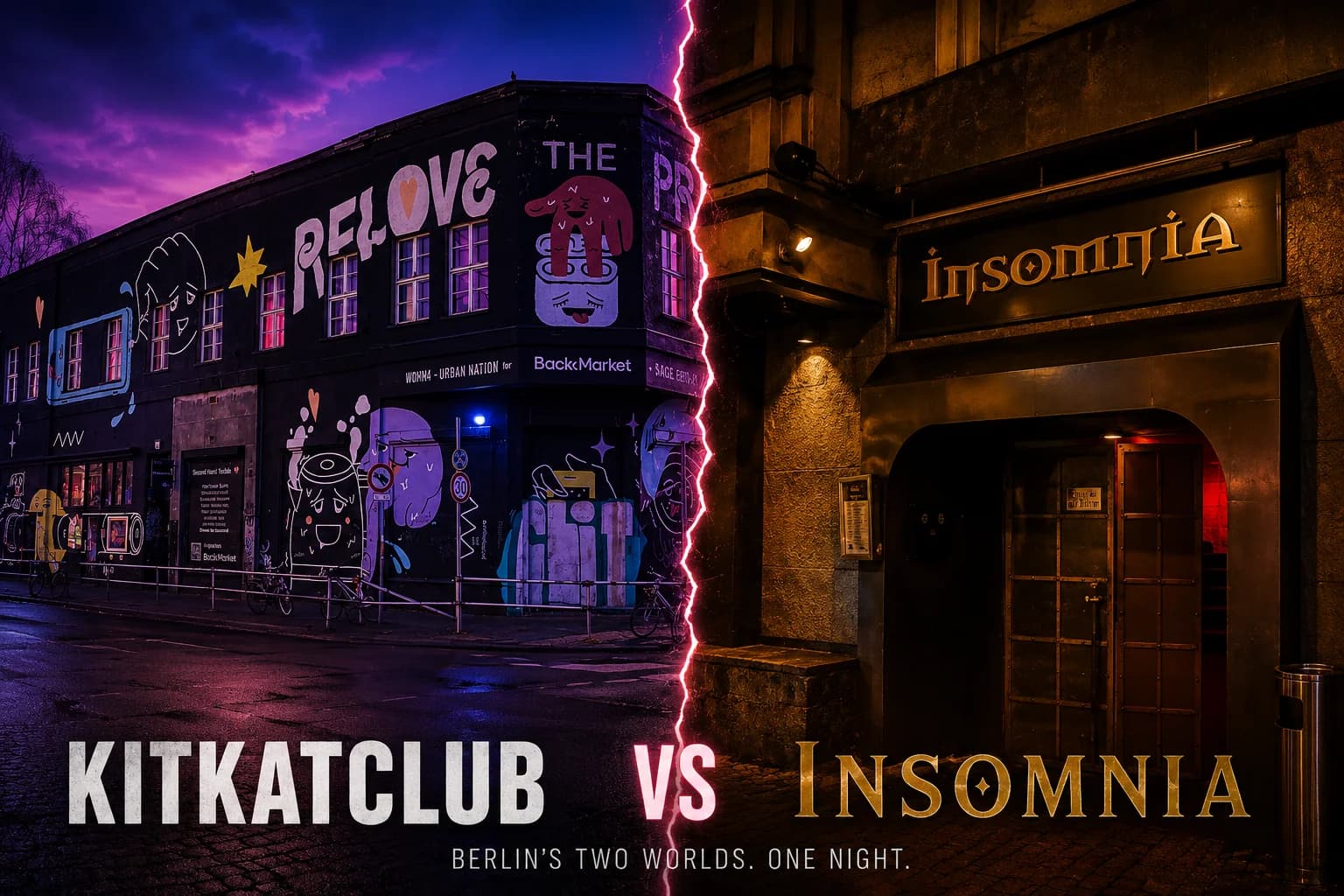
Atmosphere, History, and Space
If you spend enough time around Berlin’s sex-positive scene, one comparison keeps coming back:
KitKat or Insomnia?
Which one is better for a first time?
Which one is more sexual?
Which one feels safer?
Which one is more fetish-oriented?
Which one is easier to navigate socially?
But before answering any of those questions, there is something more important to understand:
These two clubs are not simply different venues hosting similar nights. They represent two very different interpretations of Berlin’s sex-positive nightlife culture.
Comparing them is almost like comparing two different emotional languages.
Both are hedonistic.
Both have dance floors.
Both are deeply tied to Berlin’s fetish and sex-positive scene.
And yet, the experience of being inside them feels completely different.
This first part focuses on the clubs themselves: their history, identity, atmosphere, and the feeling of moving through their spaces.
KitKatClub
Chaos, Exploration, and Collective Energy
KitKatClub was founded in 1994 by Austrian pornographic filmmaker Simon Thaur and his partner Kirsten Krüger. It emerged from Berlin’s early post-wall techno and fetish culture, a period where abandoned buildings, underground parties, and radical experimentation shaped much of the city’s nightlife identity.
Even today, KitKat still carries that feeling.
Not polished freedom.
Raw freedom.
The club itself feels almost alive. Industrial, imperfect, surreal. Ultraviolet lights wash over fluorescent paintings and bodies moving through corridors, staircases, dark corners, bars, and dance floors that seem to constantly unfold into something else.
You rarely experience KitKat as a sequence of rooms.
You experience it as movement.
One moment you are on a crowded dance floor under intense techno, a few minutes later you are near the famous pool, then suddenly in a quieter side room with completely different music, before ending up somewhere darker and more intimate.
The club almost encourages wandering.
It is labyrinthic in the best possible sense. You don’t really navigate it with a clear plan. You drift through it.
And this changes the psychology of the night.
KitKat often feels collective rather than personal. Things happen in front of others. Visibility is part of the atmosphere. Even intimacy can feel strangely public, absorbed into the larger movement of the club itself.
The sensory experience is intense:
- ultraviolet lighting everywhere
- fluorescent art glowing under black light
- dense crowds
- sound constantly overlapping
- smoke blending into the visual chaos
- bodies moving through the space at all times
For some people, this feels liberating.
For others, overwhelming.
But it rarely feels neutral.
One of KitKat’s strengths is also its unpredictability. The club hides little “micro-worlds” within itself: smaller rooms with completely different moods, bars that feel disconnected from the main chaos, vintage details that almost seem accidental, mirrored bathrooms that become social spaces on their own, and hidden corners where the energy suddenly shifts.
You can spend years going there and still discover details or corners you somehow never noticed before.
Another element that strongly shapes the atmosphere of KitKat is the presence of performance and spectacle as part of the night itself.
Depending on the party, it is very common to encounter live music performances, dancers, shibari demonstrations, costume performances, stage acts, pole dancing, impact play, or other forms of artistic and erotic expression integrated directly into the club experience.
In many ways, KitKat often feels not only like a club, but also like a constantly evolving show where the crowd itself becomes part of the performance.
Insomnia can absolutely host performances as well, but in general the atmosphere tends to feel less theatrical and less centered around collective spectacle.
Even the smoking culture contributes to the atmosphere. Smoking is widespread inside the venue and becomes part of the raw Berlin underground aesthetic. Depending on the person, this either reinforces the immersive feeling or becomes exhausting after many hours.
At this point almost mythical in Berlin nightlife culture, the outdoor but covered pool area changes the rhythm of the night completely. It creates moments where the club suddenly stops feeling like a club at all and starts resembling some strange parallel reality where techno, fetish culture, intimacy, exhibitionism, and social interaction all blend together into one continuous flow.
Insomnia
Intimacy, Structure, and Decadent Escape
Insomnia emerged from Berlin’s fetish party scene in the mid-1990s, originally beginning as a party series before evolving into a permanent venue under the direction of Dominique, a long-standing figure in Berlin’s BDSM and fetish culture.
Compared to KitKat, Insomnia feels less accidental and more intentional.
The difference starts immediately with the space itself.
Where KitKat feels industrial and chaotic, Insomnia feels theatrical.
Red velvet drapes.
Warm, dim lighting.
Iron chandeliers.
Antique furniture.
The atmosphere is closer to a decadent gothic lounge than to an underground warehouse rave.
If KitKat often feels like movement and exposure, Insomnia feels more like immersion and enclosure.
The venue is also smaller, but in a way that many people actually appreciate. Instead of endless wandering, the club has clearer layers:
- the basement dance floor that extends into a BDSM area
- the main dance floor and central social space
- more intimate play areas hidden behind curtains
- shower and jacuzzi area
- upstairs sections overlooking the dance floor
You understand the geography of Insomnia relatively quickly. The club becomes familiar fast.
The upper play areas especially create a very different dynamic from KitKat. This area is reserved for couples, women, or invited guests. The atmosphere is still wild, but the absence of single men changes the social dynamics significantly.
Paper towels and disinfectant sprays are usually available, reinforcing a stronger feeling of structure and hygiene.
This reflects a broader difference between the clubs:
KitKat often embraces chaos.
Insomnia tends to curate the experience.
Even the sensory rhythm is different.
KitKat constantly pushes stimulation outward.
Insomnia pulls you inward.
The lighting is softer. The visual pace is slower. The club breathes more.
And unlike KitKat, smoking is separated into a dedicated area, which changes the feeling of the air and the overall comfort of long nights significantly.
Where KitKat can feel like being swallowed by the night, Insomnia often feels like stepping into a parallel lounge outside normal time.
The Club Does Not Fully Define the Night
One important nuance that many people misunderstand:
The venue itself is only part of the experience.
Both KitKat and Insomnia host many different organizers and event concepts, and this can dramatically change the atmosphere of a night.
Some parties are more fetish-heavy.
Others are more techno-oriented.
Some are highly sexual.
Others are much more social, artistic, queer, playful, or experimental.
Both clubs also host their own “house nights,” which usually reflect the club’s core identity more strongly.
This means that choosing the party is often just as important as choosing the club itself.
A person can love one night at KitKat and dislike another completely. The same applies to Insomnia.
Understanding the organizers, crowd, music style, and intention behind a specific event matters a lot more than many first-timers realize.
Door Culture
A quick but important note.
Like many Berlin clubs, both venues have door selection.
The strictness depends heavily on the event, but in general:
- KitKat tends to feel stricter and sometimes less conversational at the entrance
- Insomnia often feels slightly more relaxed and direct
In both cases, understanding the party, respecting the dress code, and arriving with the right attitude matters much more than trying to “perform” something artificial.
Berlin doors usually react badly to performance and much better to authenticity.
Another practical aspect to consider is the queue.
Both clubs can have long waiting lines, especially on popular nights, but KitKat is particularly known for this. Depending on the event, weather, and timing, waiting outside can easily become part of the experience itself.
For this reason, arriving earlier is usually recommended.
That said, the line is not always a bad thing. Especially in Berlin’s sex-positive scene, it often becomes a small social space on its own where people start talking, commenting outfits, sharing expectations about the night, or casually connecting before even entering the club.
However, for people who plan to explore Berlin’s sex-positive nightlife more regularly, the Kink-Y Pass can make the experience significantly smoother.
Depending on the event, it may include benefits such as queue skipping, ticket discounts, partner perks, and easier access to selected parties at venues like KitKat and Insomnia.
Beyond the practical advantages, it has also become a simple way for regular community members to stay connected with the broader Kink-Y ecosystem both online and offline.
Quick Comparison Overview
| Aspect | KitKat | Insomnia |
|---|---|---|
| General feeling | Chaotic, collective, exploratory | Intimate, structured, immersive |
| Aesthetic | Industrial UV dreamscape | Gothic decadent lounge |
| Movement through space | Labyrinthic and fluid | Layered and intentional |
| Energy | Public and expansive | Private and contained |
| Atmosphere | Raw Berlin underground | Curated erotic escape |
| Smoking | Common throughout the club | Mostly separated |
| Sensory experience | Intense and overstimulating | Warm and controlled |
| Scale | Big and constantly moving | Smaller but layered |
| Hidden gems | Endless side spaces and surprises | BDSM basement, shower areas |
Final Thoughts
From the outside, KitKat and Insomnia may seem similar.
Both are sex-positive.
Both are hedonistic.
Both belong deeply to Berlin’s nightlife mythology.
But once inside, they move in completely different directions.
KitKat expands outward into chaos, movement, and collective energy.
Insomnia folds inward into intimacy, atmosphere, and structure.
Neither is objectively better.
They simply optimize for different emotional experiences, and understanding that difference is probably the most important first step before choosing where your night begins.
In the second part of this guide, we moved from the clubs themselves to the people inside them: the crowd, the dress code, the expectations, and the social dynamics that shape the experience.