
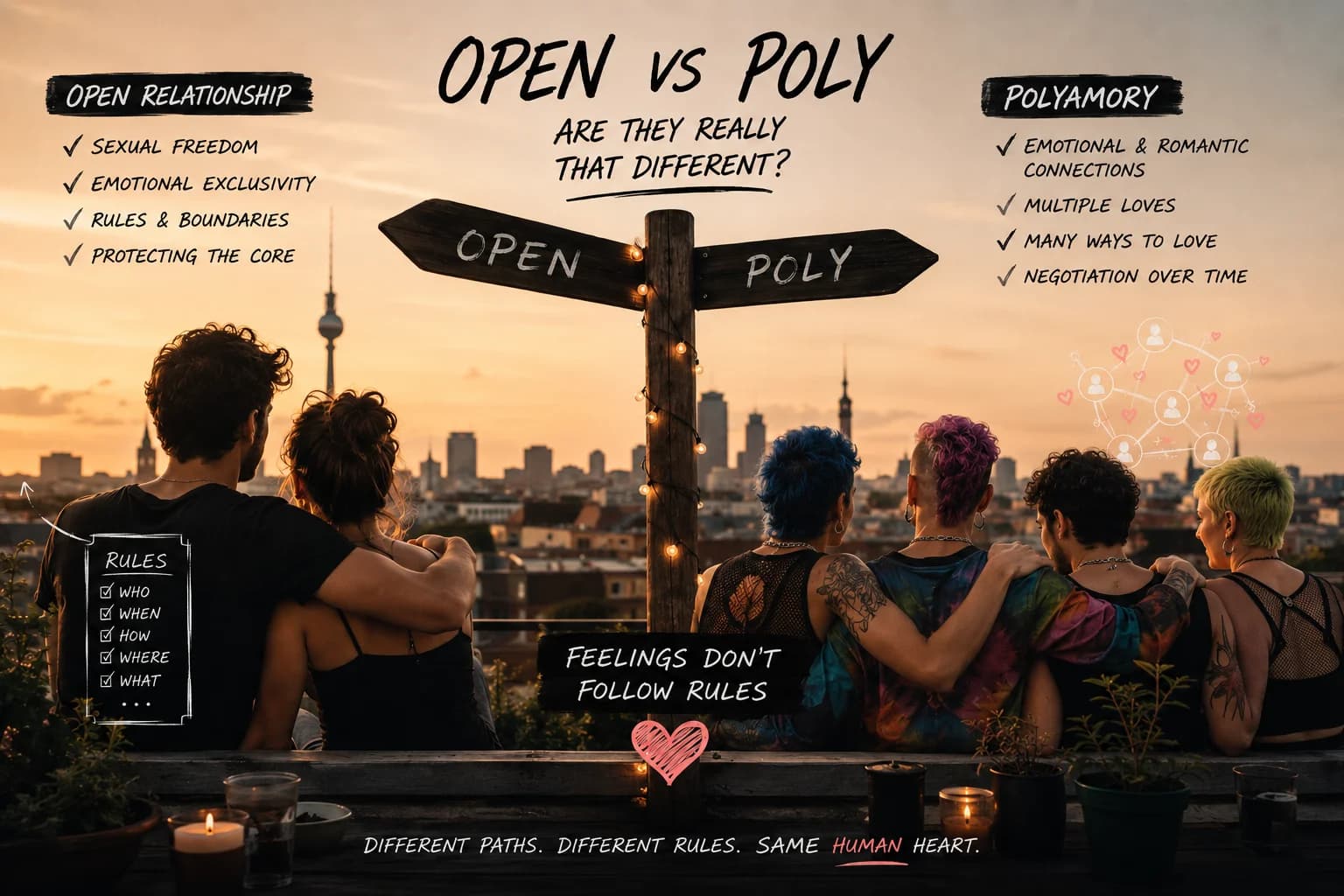
Open Relationships vs Polyamory
When people talk about non-monogamy, two labels come up again and again: open relationship and polyamory.
At first glance, the difference seems clear.
An open relationship is usually understood as a couple that allows sexual experiences outside the relationship, while keeping emotional exclusivity.
Polyamory, on the other hand, is about allowing multiple emotional and romantic connections, not just physical ones.
Simple enough.
But if you spend some time inside sex-positive communities, especially in places like Berlin, you start to notice something: these definitions are clean on paper, but much less defined in real life.
Because relationships are not built on labels. They are built on people, and people are rarely that predictable.
Labels Are Useful, But Limited
Labels like “open” or “poly” are helpful. They give a general direction. They help people communicate faster.
But they only describe a macro area.
Behind those labels, every relationship has its own structure, its own agreements, its own boundaries, its own history.
Two open relationships can be completely different from each other.
Two poly relationships can function in ways that almost have nothing in common.
Even within polyamory, there are many different approaches:
- Hierarchical polyamory, where there is a primary relationship and others are secondary
- Kitchen table poly, where everyone is comfortable interacting together
- Parallel poly, where relationships exist separately with minimal interaction
- Solo poly, where autonomy is central and there is no primary partner
And this is just a small part of the spectrum.
So before even comparing “open” and “poly”, it’s important to recognize that these words do not define the full reality. They simply point in a direction.
Where Things Start to Blur
If we keep the classic distinction, the difference seems to revolve around one key point:
- open = sexual openness
- poly = emotional openness
But this is also where things start to get complicated.
Because emotions are not something we can fully control.
You can decide to sleep with someone.
You can agree on rules.
You can define boundaries.
But you cannot always decide whether you will feel something.
And this is where, in many cases, the line between open and poly starts to blur.
The Role of Rules
Many open relationships start with rules. Sometimes a few, sometimes a lot.
Who can do what.
How often.
With whom.
What is allowed and what is not.
What needs to be shared, and what stays private.
These rules often come from a good place.
They reduce insecurity.
They create structure.
They help both partners feel safer while exploring something new.
But they also do something more subtle.
They can create a feeling of uniqueness. A sense that “what we have is still different, still above everything else.”
A kind of implicit hierarchy.
The question is: do these rules actually create that uniqueness, or do they mostly help us feel it?
Because when emotions start growing outside of those rules, that feeling can be tested very quickly.
Emotional Leakage
One pattern that comes up again and again is what could be called emotional leakage.
A relationship opens for physical exploration.
Connections happen.
Time is spent together.
Conversations go deeper.
And at some point, feelings start forming.
Not because anyone planned it.
Not because anyone broke a rule on purpose.
But simply because humans connect.
And once feelings are there, things become less clear.
Is it still “just open”?
Is it becoming something else?
Was it ever purely one thing to begin with?
A Question of Control
At this point, another layer appears.
Many open relationships are built on agreements that try to separate sex and emotions.
But how much control do we really have over that separation?
It is easy to agree on boundaries when nothing has happened yet.
It is much harder to maintain them when real connections start forming.
This is not a failure. It is not necessarily a mistake.
It is simply a reminder that there is a difference between what we intend and what we are actually able to control.
Is Open Just a Stage?
After seeing enough stories, a question starts to take shape.
Not a conclusion. Just a question.
How different are open and poly, really?
And if emotions tend to develop naturally over time, is an open relationship sometimes just an earlier stage of something that might evolve?
Not inevitably. Not for everyone.
Some people maintain open relationships without emotional overlap.
Some people close their relationship again.
Some redefine their agreements instead of expanding them.
But it is also hard to ignore how often the shift happens.
Not as a plan.
But as a consequence.
Promises vs Reality
This leads to a more uncomfortable reflection.
When people define an open relationship with strict emotional boundaries, they are often making promises about something that is not entirely under their control.
You can promise honesty.
You can promise communication.
You can promise respect.
But can you promise the absence of feelings?
And if feelings do grow anyway, what does that mean for the original agreement?
No Clear Answers
This is not an argument against open relationships.
It is not an argument for polyamory.
It is simply an observation.
Labels help. Rules help. Agreements help.
But relationships are still lived in real time, with real emotions, real people, and real unpredictability.
So maybe the question is not:
“Is this open or poly?”
But rather:
What are we actually ready to navigate once things stop going exactly as planned?
And how honest can we be, not only with each other, but also with ourselves, about what we can and cannot control?