
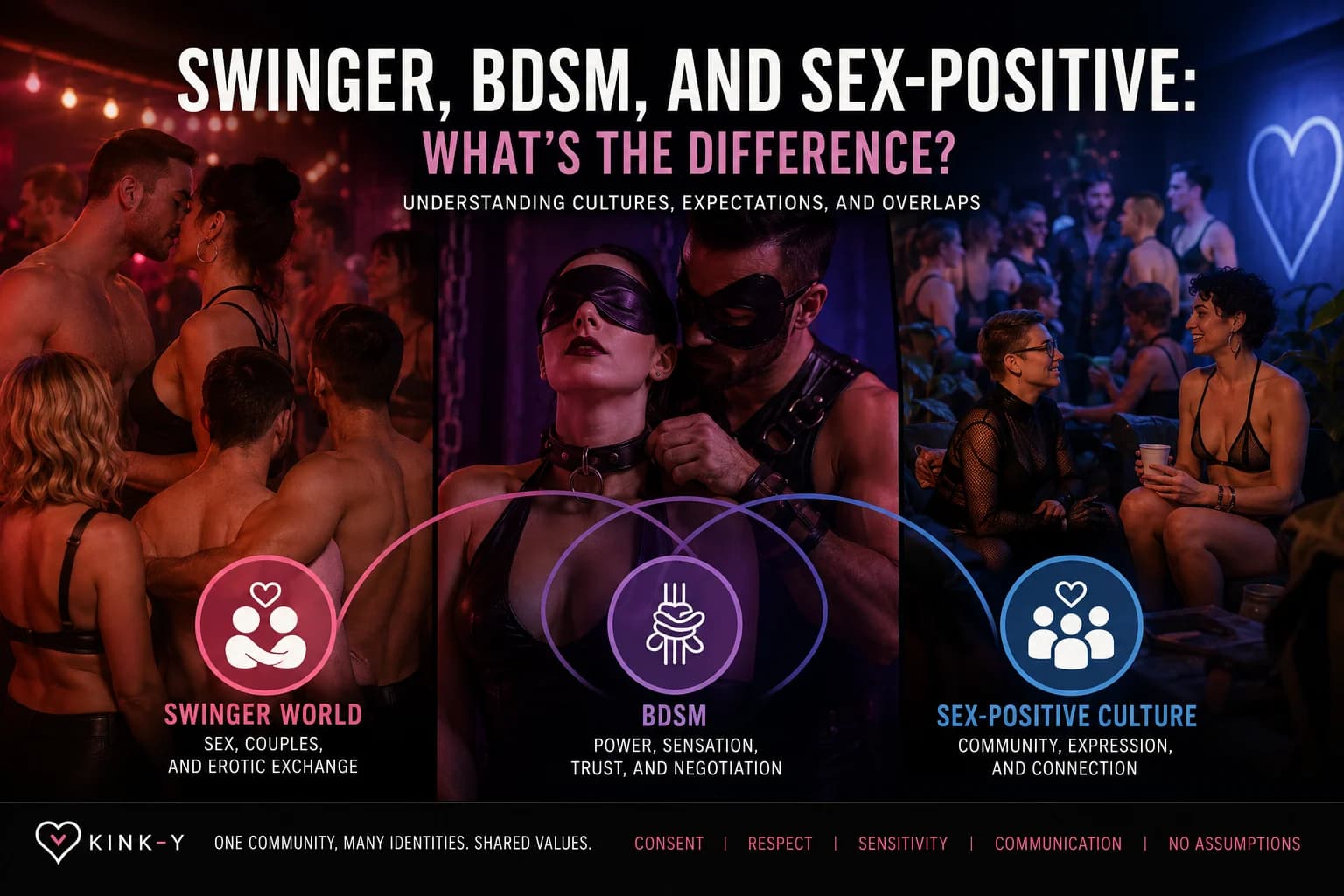
Why These Words Get Confused
When people first enter alternative sexual communities, a few words appear everywhere:
- Swinger
- BDSM
- Kinky
- Sex-positive
- Open
- Poly
- Play party
At the beginning, they may look like different names for the same world.
They all seem to involve sexuality, freedom, erotic exploration, non-traditional relationships, and spaces where people can express desires that are often hidden in everyday life.
But they are not the same thing.
They overlap, of course. Sometimes a lot. The same person can be a swinger, kinky, polyamorous, and part of a sex-positive community at the same time. A party can include swinger dynamics, BDSM scenes, queer expression, and a sex-positive atmosphere all in one night.
So this article is not about drawing hard borders.
These labels are useful because they help us understand the general direction of a space. But they are not perfect definitions. They describe macro areas, not full identities.
Inside each world, there are many variations. Some swinger spaces feel very close to sex-positive culture. Some sex-positive events can feel very direct and sexually focused. Some BDSM spaces may be deeply erotic, while others may have very little sex at all.
The better way to understand these words is not as boxes.
It is as centers of gravity.
Each world tends to organize itself around a different main focus.
Labels Are Useful, But Not Clean Borders
A label can help you understand what kind of event you are entering.
But the label alone is never enough.
A “swinger party” can be elegant, respectful, couple-centered, direct, and highly organized. Or it can feel more social, more playful, more connection-based, and closer to a broader sex-positive environment.
A “sex-positive event” can be community-oriented, queer, artistic, and educational. Or it can be very sexual and play-focused.
A “BDSM event” can involve intense scenes, technical practice, workshops, rituals, power exchange, rope, impact play, or simply people socializing around shared interests.
General distinctions are useful.
Generalizations are dangerous.
The real question is not only:
“What label is used?”
The better question is:
“What is this space actually built around?”
Is it built around sexual exchange? Kink practice? Community? Education? Music? Couples? Queer expression? Play with a strong social layer?
The answer changes everything.
The Swinger World: Sex, Couples, and Erotic Exchange
Swinger culture is one of the older and more established worlds in non-monogamous sexuality.
Traditionally, it is often organized around couples, sexual exchange, partner swapping, threesomes, foursomes, and erotic social events where people attend with the idea that sex may happen if there is attraction, chemistry, and compatibility.
Of course, not every swinger event is the same.
Some are elegant and selective. Some are casual. Some are strongly couple-centered. Some welcome singles. Some are more open to queer dynamics. Some are mostly heterosexual. Some feel social and warm. Others feel more transactional.
In general, though, swinger spaces are not usually the most typical home for queer community culture.
Many swinger environments are still mostly organized around cis, heterosexual, and bisexual couple dynamics. Trans women may be present, and some swinger spaces are more diverse than others, but the variety of gender identities, queer expressions, and relationship models is usually broader in sex-positive communities.
Again, this is not a rule and not a judgment. It is simply part of the cultural difference between spaces.
Historically, the swinger world has often been more directly sex-centered than many sex-positive spaces.
In many swinger environments, sex is closer to the purpose of the room.
People do not necessarily expect to play with everyone, and attraction still matters enormously, but the basic frame is often clear: if the match is right, erotic or sexual interaction is part of what people came for.
Another common difference is that many swinger couples do not date separately.
Again, this is not universal. But often, the couple remains the main unit. People may explore together, play together, swap together, or meet other couples together, without necessarily creating separate romantic or emotional connections outside the couple.
This is one of the differences with many sex-positive, open, or polyamorous environments, where people may also explore individually, date separately, build independent connections, or develop relationships that go beyond one night of play.
This does not make one model better than the other.
It simply means that the structure and expectations can be different.
Sex-Positive Culture: The Bigger Umbrella
Sex-positive culture is harder to define because it is broader.
It is less a specific practice and more a cultural frame.
A sex-positive space may include sexuality, but also consent education, queer culture, body positivity, kink, BDSM, erotic art, workshops, community, play parties, open relationships, polyamory, performance, discussion, and social experimentation.
Sex may happen. Often, sex does happen. But in many sex-positive spaces, sex is not the only reason the space exists.
This is one of the key differences.
In many swinger spaces, sex is closer to the purpose of the room. In many sex-positive spaces, sex is one of the possibilities the room allows.
That distinction matters.
A person may attend a sex-positive event to dance, learn, socialize, explore identity, understand their desires, meet like-minded people, experience nudity in a shame-free context, join a workshop, flirt, play, or simply feel part of a community where sexuality is not treated as something dirty or hidden.
This means that the social layer is often stronger.
In sex-positive communities, people may create friendships, relationships, collaborations, creative projects, emotional support networks, and long-term social bonds that go far beyond sexual interaction.
We have seen people meet at events and later work together, travel together, spend holidays together, support each other, go out with children, become friends, lovers, partners, or chosen family.
This can happen in swinger communities too, of course.
But sex-positive communities often put the community layer more visibly at the center.
BDSM: Power, Sensation, Trust, and Negotiation
BDSM is another world again.
From the outside, many people assume BDSM means “more extreme sex.”
But that is often a misunderstanding.
BDSM can be deeply erotic, but it is not always centered on sex.
Sometimes it is about power, sensation, control, surrender, discipline, rope, impact, service, ritual, fear, trust, vulnerability, or emotional intensity.
Sex may be present, but it is not always the point.
In some BDSM spaces, there may actually be less sex than in a sex-positive party or a swinger event, because the focus is elsewhere.
A rope scene can be erotic without becoming sexual. An impact scene can be intimate without involving genital contact. A power exchange can be emotionally intense without looking like sex at all.
This is one reason BDSM culture often develops a very strong language around communication.
Many practices are not standard. Risks can be physical, emotional, psychological, or relational. One person’s fantasy can be another person’s hard limit. Even a word like “rough” can mean completely different things to different people.
BDSM people are often used to discussing limits, roles, safewords, intensity, aftercare, experience level, health issues, emotional triggers, and consent frames in much more detail than people from other environments.
Sometimes this even includes written forms, checklists, negotiation sheets, or explicit agreements before a scene.
This does not mean every BDSM space is automatically safer.
No label guarantees safety.
But BDSM culture often has more explicit tools for negotiation, because the practices themselves require it.
For this reason, people coming from BDSM environments sometimes feel that consent in other communities is too vague, too casual, or not explicit enough compared to their standards.
And sometimes they are right.
At the same time, other communities may rely more on social flow, body language, gradual escalation, and organic interaction.
The important thing is to understand that these are different cultural codes.
Where These Worlds Overlap
In real life, the borders are blurry.
- A swinger couple may also enjoy BDSM.
- A BDSM practitioner may attend sex-positive parties but have no interest in partner swapping.
- A sex-positive person may enjoy erotic group dynamics without identifying as a swinger.
- A polyamorous person may attend play parties for connection, not only for sex.
- A queer person may be kinky, open, non-monogamous, and community-oriented without fitting neatly into any one label.
And sometimes, entire events sit in the overlap.
A party may have the sexual directness of a swinger event, the aesthetics of a fetish party, the consent language of BDSM, and the social atmosphere of a sex-positive community.
This is especially true in cities like Berlin, where scenes often mix, evolve, influence each other, and borrow language from one another.
So the goal is not to ask:
“Which label is correct?”
The better question is:
“Which expectations are people bringing into the room?”
Because that is where misunderstandings often begin.
Where Misunderstandings Happen
Most problems do not happen because people are evil.
They happen because people enter the same room with different dictionaries.
A person coming from a swinger background may expect a more directly sexual atmosphere. They may assume that people attending a certain kind of party are more open to sexual proposals, couple dynamics, or explicit flirting, especially if there is attraction and compatibility.
A person coming from a BDSM background may expect more detailed negotiation before any physical or erotic interaction happens.
A person coming from a sex-positive community may expect more social connection, more emotional nuance, more queer awareness, more attention to community dynamics, and less assumption that sexual availability is the main reason for being there.
For many people in sex-positive spaces, sex is a possibility, not an assumption.
Someone may be there to dance, socialize, explore the atmosphere, meet like-minded people, feel free in their body, connect with friends, attend a workshop, enjoy nudity, flirt lightly, or simply experience a space where sexuality is not hidden or judged.
This difference can create confusion.
One person may think:
“We are all here for sexual exploration, so a direct approach makes sense.”
Another person may think:
“We are in a sex-positive space, so I expect more context, connection, and sensitivity before any sexual approach.”
Neither person is necessarily wrong in their own cultural frame.
But if they do not understand that they are using different codes, the interaction can become uncomfortable very quickly.
A good example is solo masturbation in play areas.
In many sex-positive spaces, the figure of the “solo wanker” is increasingly seen as intrusive, disconnected, or simply not aligned with the spirit of the space. The problem is not masturbation itself, but the lack of interaction, mutuality, and shared consent around it. It can easily feel like someone is consuming the room rather than participating in it.
At the same time, in some strictly gay male party contexts, similar behaviour may be part of the social and sexual code of the space. It can function as a way to express interest, signal availability, or participate in the erotic atmosphere.
This is exactly why understanding the code of a specific space matters so much.
The same action can be read as normal, welcome, awkward, or inappropriate depending on where it happens, who is involved, and what the shared expectations of the room are.
The more mixed the space is, the less assumptions work.
This is why communication matters so much.
How to Choose the Right Space for You
Before attending an event, it helps to ask yourself what you are actually looking for.
- Are you mainly looking for sexual play?
- Are you looking for couple-to-couple dynamics?
- Are you interested in BDSM practice, power exchange, rope, impact, or technical exploration?
- Are you looking for community, friendship, and long-term social connection?
- Are you curious about open relationships or polyamory?
- Do you want to attend as a couple, alone, or with friends?
- Do you want to date separately or only together?
- Do you prefer explicit negotiation or more organic social flow?
- Do you want a queer-inclusive environment?
- Do you want sex to be expected, possible, or secondary?
These questions matter more than the label on the flyer.
Many events use words like sex-positive, kinky, fetish, play party, BDSM, or swinger in flexible ways. Sometimes they are accurate. Sometimes they are used because they sound attractive. Sometimes different people understand them differently.
So read the event description carefully.
Look at the organizers.
Ask people who have attended before.
Check what kind of crowd usually goes there.
And most importantly, do not assume that one word tells you everything.
The label is the beginning of the research, not the end.
Where Kink-Y Fits
Kink-Y is first of all a sex-positive community.
That means we are not simply a swinger community, and we are not only a BDSM community with a dance floor.
We are a broader umbrella where different cultures, desires, identities, and relationship models can meet.
- Swingers are welcome.
- BDSM people are welcome.
- Kinky people are welcome.
- Queer people are welcome.
- Trans and non-binary people are welcome.
- Open and poly people are welcome.
- Curious beginners are welcome.
- People who do not know exactly which label fits them yet are welcome too.
But the label is not the most important part.
The values are.
- Consent
- Respect
- Sensitivity
- Communication
- Curiosity
- No assumptions
- Willingness to learn
- Ability to understand that other people may come from completely different backgrounds
That is essential.
Because when different worlds meet, assumptions become dangerous very quickly.
A swinger approach may not work with someone who comes from BDSM culture. A BDSM-style negotiation may feel too formal for someone used to organic social flow. A sex-positive community may feel confusing for someone who expected a more direct sexual environment.
None of this is a problem if people communicate.
It becomes a problem when people assume.
Kink-Y works best when people enter the space with openness, but also humility.
Not everyone is there for the same reason.
Not everyone uses the same language.
Not everyone has the same boundaries.
And not everyone wants the same kind of connection.
That diversity is exactly what makes the community interesting.
But it also requires awareness.
Final Thoughts
Swinger, BDSM, and sex-positive worlds are connected, but they are not identical.
Swinging is often more centered around sexual exchange and couple dynamics.
BDSM is often more centered around power, sensation, trust, technique, and explicit negotiation.
Sex-positive culture is often a broader umbrella where sexuality, community, identity, education, expression, and connection can coexist.
But these are only tendencies.
There are no perfect borders.
People move between worlds. Events borrow from each other. Communities evolve.
And labels, while useful, never replace communication.
So instead of asking only:
“Is this swinger, BDSM, or sex-positive?”
Maybe the better question is:
“What is this space actually built for?”
And even more importantly:
“What assumptions am I bringing with me when I enter it?”