
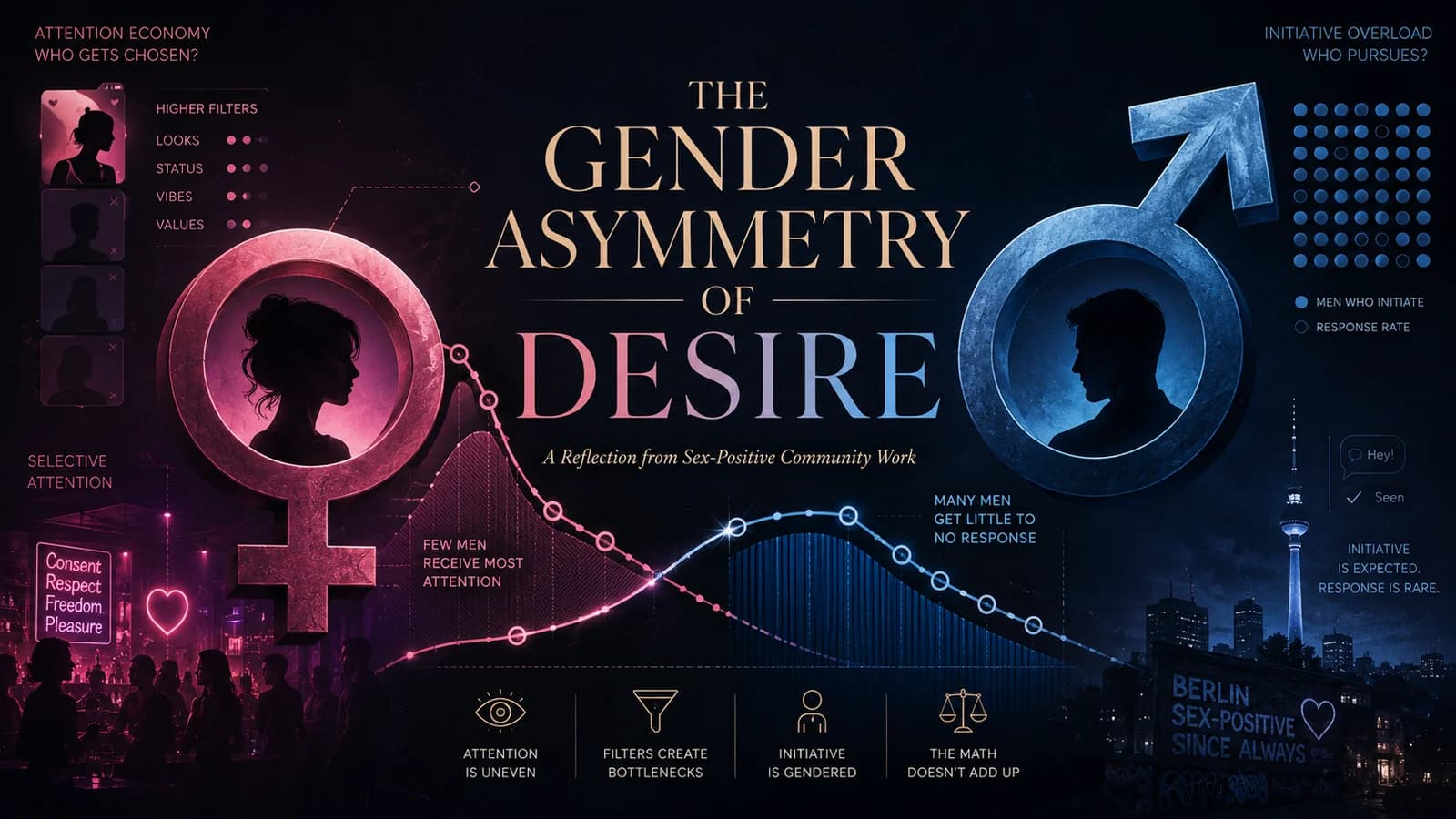
Desire Is Not Always Symmetrical: A Reflection from Sex-Positive Community Work
Berlin is often seen as one of the most progressive cities in Europe when it comes to sexuality, feminism, queer culture, non-monogamy, and personal freedom.
And in many ways, this is true.
In sex-positive spaces, we see more and more women exploring their sexuality openly, coming to parties alone, questioning old relationship structures, asking partners for more freedom, and giving themselves permission to follow desire instead of only following social expectations.
This is beautiful. It matters. And it is part of the cultural change many of us wanted to see.
But from the point of view of people organizing events, moderating communities, managing registrations, and building tools for connection, another pattern also becomes visible.
Even in progressive spaces, desire does not always move symmetrically.
The values may be equal. The rights may be equal. The language may be equal. But the effort, the initiative, the risk, the attention, and the numbers often still seem very uneven.
This article is not an attempt to explain every man, every woman, or every identity. It is not a universal theory of gender, sexuality, or desire.
It is a reflection from our specific position: running a sex-positive community, organizing events, observing registrations, moderating interactions, listening to people, and building tools like Nixie.
We also know that queer, gay, bisexual, trans, non-binary, and other constellations can have very different dynamics. We cannot speak for all of them. If someone from those perspectives wants to write about these dynamics from their own experience, we would be happy to publish that contribution.
What we can speak about is what we see from our own corner of the jungle.
And what we see, again and again, is that equality in values does not automatically create symmetry in behaviour.
The Uneven Math of Attention
One of the easiest places to observe this is dating apps.
Almost every dating app seems to tell a similar story: men are usually overrepresented, women receive more attention, and the effort required to get a match is not distributed equally.
For many men, dating apps become a numbers game. They swipe more, write more, get ignored more, and often stop reading profiles carefully because the probability of a response feels too low. The logic becomes almost mechanical: swipe first, check later.
For many women, the experience is almost the opposite. The problem is not scarcity, but overload. Too many messages. Too many likes. Too much filtering. Too much noise. Too much need to decide who is safe, interesting, respectful, attractive, mature, and worth the energy.
From outside, it is easy to moralize this.
One person might say: “Men are shallow and just swipe on everyone.”
Another might say: “Women are too selective and impossible to please.”
But maybe both reactions are too simple.
Maybe what looks like shallowness from one side is partly a reaction to scarcity.
Maybe what looks like passivity or excessive selectivity from the other side is partly a reaction to being constantly approached.
In other words, what we call “behaviour” may often be behaviour shaped by numbers.
And once the numbers are uneven, the whole culture around desire changes.
Sex-Positive Events Show the Same Pattern
This dynamic does not stay inside dating apps.
It appears in sex-positive parties too.
Anyone who has organized gender-balanced events knows how difficult this can be. Registrations from men often arrive quickly and in large numbers. Registrations from women usually arrive more slowly, in smaller numbers, or with more hesitation.
This does not mean women are less sexual. That would be a lazy conclusion.
Many women are deeply curious, playful, adventurous, and sexually expressive. Many are exploring more than ever before. Many are actively reshaping their relationships, opening up, attending parties alone, and claiming space in ways that would have been much harder in the past.
But the way this desire moves through the world often looks different.
Men often rush toward access.
Women often filter access.
And for organizers, this difference becomes extremely concrete.
In gender-balanced events, women often shape the final numbers. If there are not enough women registered, the event may become difficult to balance. Sometimes it may even become impossible to run in the intended format.
Meanwhile, many men may be ready, interested, verified, respectful, and still remain on waiting lists.
This creates a situation for which on paper, everyone is equal.
In practice, the demand is not equal.
This is one reason why some organizers charge men more for certain events. It is not necessarily because they believe this is ideal. It is often because the demand from one side is five or ten times higher, and price becomes one of the simplest tools to control the imbalance.
But price is a very crude filter.
It selects for financial capacity, not necessarily for sensitivity, emotional intelligence, consent awareness, maturity, kindness, or social skill.
And this is one of the reasons we find the topic so complicated.
The imbalance is real. But many of the common solutions are imperfect.
What We See in Kink-Y and Nixie
We see similar patterns inside Kink-Y.
When we open registrations for certain events, men usually register faster. They are often more willing to go through the annoying steps required to access a space: creating a profile, getting verified, waiting, sending requests, following instructions, trying again.
The same happens in Nixie.
The number of men willing to go through verification is much higher. The frequency of use is higher. The number of crushes and DM requests sent is higher. The visible effort is higher.
Again, this does not automatically mean men desire more.
It may mean that men are more used to having to act.
It may mean that men know that, if they do not make a move, very little will happen.
It may mean that women, receiving more attention, can afford to be more selective.
It may mean that women carry more risk and therefore approach more carefully.
It may mean all of these things at the same time.
But whatever the reason, the result is visible: the effort to initiate contact is not evenly distributed.
Who Makes the First Move?
This becomes even clearer when we talk to people directly.
Many men tell us, in different ways, that they feel they need to make the first move. At a bar, at a munch, at a party, on an app, in a conversation, on the dance floor.
They know that if they want to get closer to someone, they usually need to take the risk of approaching.
And, depending on the psychological profile, that risk is not small.
They risk being rejected. They risk being awkward. They risk being seen as too much, too forward, too sexual, too intrusive. In sex-positive spaces, where consent and sensitivity are rightly taken very seriously, many men also carry the fear of making a mistake even when their intention is respectful.
At the same time, several women have told us that they prefer to observe, feel the energy, select, and wait for someone else to make the first move.
This also makes sense.
For women, attention can be abundant but not always pleasant. Being approached does not automatically mean being approached well. Selection is not only about preference. It can also be about safety, energy, emotional labor, and protection from unwanted attention.
So the asymmetry is not simply:
“Men do all the work and women do nothing.”
That would be unfair and inaccurate.
A more honest version may be:
Men often carry more of the burden of initiative.
Women often carry more of the burden of filtering.
Both can be exhausting.
Both can create frustration.
Both can create misunderstandings.
Is This Culture, Biology, Safety, or Habit?
The difficult question is: where does this difference come from?
We do not know.
And we are suspicious of anyone who claims to know too confidently.
One explanation is cultural conditioning.
For generations, men were expected to pursue and women were expected to choose, resist, wait, or be chosen. Even when society changes, old habits do not disappear overnight. They remain in gestures, expectations, fears, fantasies, insecurities, and social scripts we absorbed long before we had the language to question them.
A second explanation is attention economy.
If one group receives much more attention, that group may naturally become more selective and less proactive. If my phone were constantly full of messages from people wanting to meet me, I would probably also spend less time searching and more time filtering.
A third explanation is safety.
Women often navigate sexual spaces with a different level of risk awareness. Even in progressive environments, the consequences of choosing badly can feel heavier. Safety, reputation, emotional labor, fear of pressure, and fear of being objectified all shape behaviour.
A fourth explanation may involve desire itself.
Maybe desire is not always activated in the same way for everyone. Maybe for some people attraction is more immediate and visual. For others, it may need more context, trust, atmosphere, emotional connection, or time. These differences may be personal, cultural, hormonal, psychological, or relational.
We should also not be afraid to ask whether biology plays some role.
Not as destiny. Not as an excuse. Not as a hierarchy. And definitely not as a way to limit people.
But as one possible part of a much larger picture that includes culture, upbringing, safety, hormones, trauma, opportunity, social expectations, personal history, and individual temperament.
The mistake would be to reduce everything to biology.
But another mistake would be to pretend biology cannot matter at all.
Between those two extremes, there is probably a more interesting conversation.
Equality Does Not Mean Sameness
One reason this topic is difficult is that many people spent decades fighting against the idea that men and women are naturally fixed into specific roles.
And that fight was necessary.
For a very long time, “difference” was used as a weapon.
Women were told they were too emotional, too fragile, too passive, too maternal, too irrational, too pure, too dangerous, too tempting, too weak, too much, or not enough.
Men were told they had to be dominant, hard, sexually available, emotionally closed, always ready, always strong, always the ones who initiate.
Many people suffered under these scripts.
So it makes sense that, for a while, the cultural answer was to say: we are equal, we can do the same things, we should not be trapped by gender.
That was necessary.
But maybe the next step is more nuanced.
Maybe equality does not require pretending that everyone behaves the same, desires the same, risks the same, or moves through sexuality in the same way.
Maybe real equality means being able to notice differences without turning them into hierarchy.
Without saying one side is better.
Without saying one side is more evolved.
Without using difference as an excuse for discrimination.
Without using difference as a prison.
The Danger of Turning Patterns Into Judgments
If we say there are differences, this should never become a way to limit individuals.
A woman can be direct, hungry, sexual, assertive, and proactive.
A man can be shy, selective, slow, emotional, and in need of safety.
A non-binary person may relate to all of this in a completely different way.
Every person is more complex than the statistical patterns around them.
But patterns still matter.
Not because they define everyone.
Because they shape the environment everyone has to move through.
Difference as a Superpower, Not a Limitation
The most important point, for us, is this:
Differences should never be used as an excuse for discrimination.
They should not be used to restrict people, shame people, price people out, exclude people, or reduce people to stereotypes.
But when differences are observed honestly and handled with care, they can become useful.
They can help us design better spaces.
They can help us understand why certain frustrations keep appearing.
They can help us avoid blaming individuals for dynamics that are partly systemic.
They can help us create better tools, better event formats, better moderation, and better expectations.
Maybe, after dismantling many old patriarchal structures, we do not need to replace them with the fantasy that everyone is identical.
Maybe we can build something more mature.
A culture where equality is not based on sameness.
A culture where difference does not mean hierarchy.
A culture where desire can be diverse without becoming a battlefield.
A culture where people are free to move differently, as long as nobody uses those differences to dominate, shame, pressure, or exclude others.
We do not have a final answer.
We are not writing this as researchers, biologists, sociologists, or gender theorists.
We are writing it as people who organize, observe, listen, moderate, build, and constantly try to understand why certain patterns keep repeating even in spaces that are supposed to be freer than the world outside.
And maybe that is enough for a first conversation.
Because if sex-positive spaces want to be truly honest, they cannot only talk about freedom, consent, and empowerment in beautiful words.
They also need to look at the strange math of desire.
- Who approaches.
- Who waits.
- Who filters.
- Who risks rejection.
- Who carries safety concerns.
- Who shapes the room.
- Who gets access.
- Who stays on the waiting list.
- Who feels powerful.
- Who feels invisible.
And how all of this keeps happening, even in spaces where everyone says they believe in equality.
Maybe the goal is not to erase these differences.
Maybe the goal is to understand them better, so they stop dividing us and start helping us build spaces where more people can actually meet, desire, play, connect, and feel free.
And who knows. Maybe this is the utopian dreamer in us speaking, but perhaps this awareness could reach beyond sex-positive spaces.
Maybe learning to understand difference, respecting it, taking care of it, without turning it into hierarchy could reshape far more than our parties, our apps, or our communities. It could reshape the dynamics of the society we live in.