
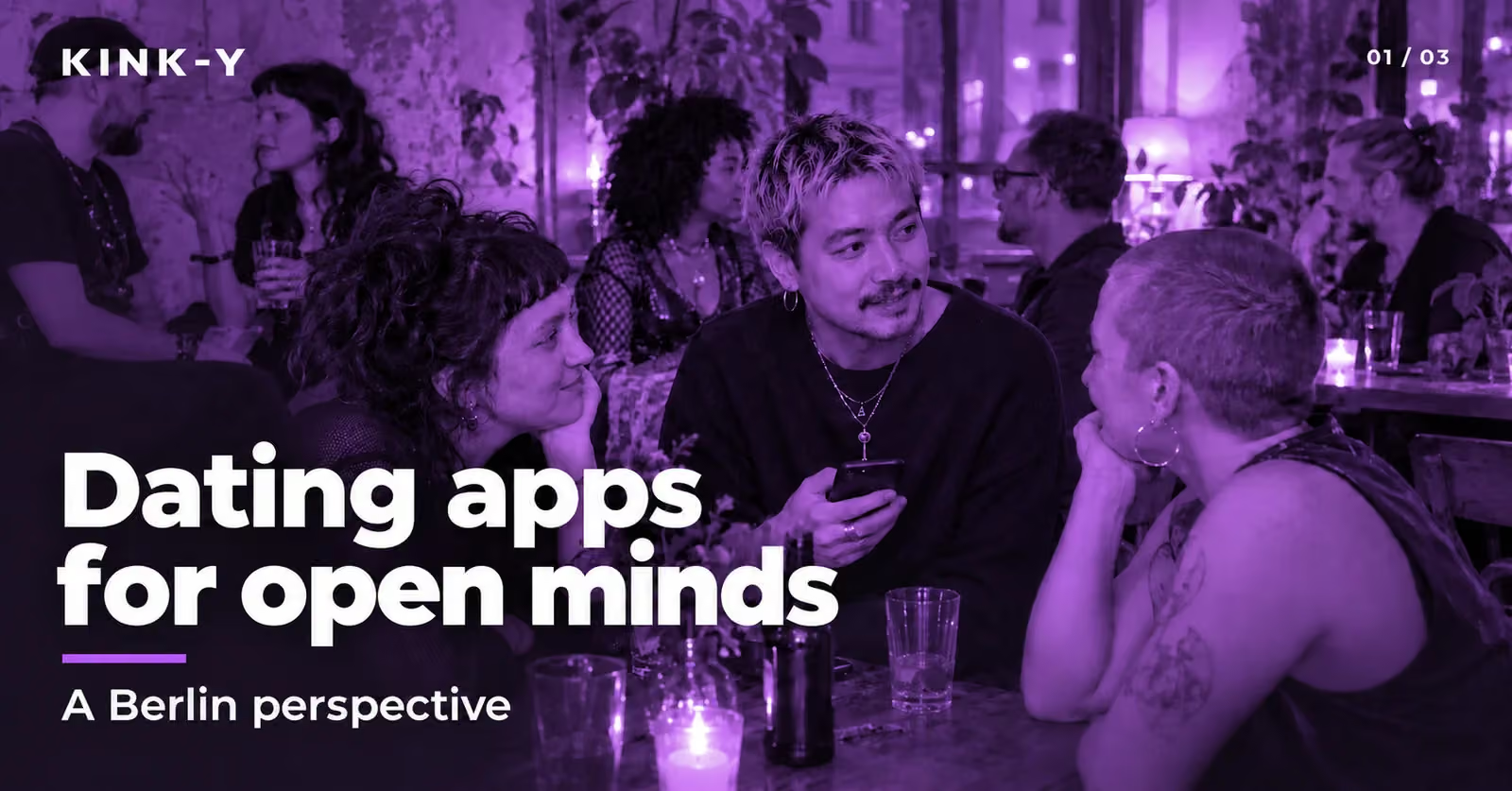
Finding a dating app is easy. Finding one where you can openly describe your relationships, desires and expectations, and meet people who understand them, can take more effort.
For those of us interested in kink, polyamory, open relationships or other ways of exploring sexuality, the choice involves more than the number of profiles available. The culture of a platform matters, as does what happens between noticing someone online and actually meeting them.
This is a personal perspective, shaped by years of online dating and building Kink-Y’s community in Berlin. It is also part of the story behind Nixie, the app we are developing around that community.
But the story starts well before Nixie, or even swiping.
In this article
- Before the swipe
- Then came Tinder
- Finding a space where less needs explaining
- Dating apps and community platforms compared
- When the conversation outgrows the chat
- What if meeting in person came earlier?
- Where Nixie fits in
- Frequently asked questions
Before the swipe
My first attempts at meeting someone online for something that might lead to sex happened on IRC. For anyone who missed that era, it was a text-based chat system. No swiping. A conversation was where you started.
Years later, around 2006, I discovered Badoo. At the time, I felt too young and too broke for something like Match.com. Badoo gave me another way to meet people and see what might happen.
It wasn’t a space specifically built around kink, non-monogamy or sexual exploration. Still, some firsts in my own sexual life came through it, including my first experience with a trans woman and my first threesome.
Not bad for a supposedly conventional dating platform.
People have always used these spaces in ways that go beyond the promise on the homepage. The platform provides a setting. The people bring their curiosity, expectations and desires.
Then came Tinder
Around 2012, someone at work told me about Tinder.
The appeal was immediate. Swiping made browsing profiles feel quick and simple, and the attention around the app made it seem like something you wanted to try.
But speed was only part of it. The principle of chatting after a mutual match addressed a familiar frustration on both sides: sending messages to people who might never be interested, or receiving a stream of messages from people you didn’t want to talk to.
A match didn’t guarantee a reply, but at least the conversation began with some interest already expressed by both people.
There was a trade-off, of course. A quick decision based largely on photographs could tell you something about attraction, but much less about compatibility. Still, having that mutual interest come before the conversation felt like a step forward.
I remember Tinder’s reputation as an app where people went to find sex. My experience was more mixed. Some people wanted something casual. Others wanted dates, a boyfriend, or a connection they could figure out along the way.
For me, one of those connections became a relationship with an American woman. We were together for two and a half years, which is probably the best illustration of how different my experience was from that reputation.
She didn’t speak Italian, so my English also improved considerably along the way. There is a certain motivation to learning a language when you actually want to understand each other.
Finding a space where less needs explaining
Having plenty of apps to choose from doesn’t necessarily mean finding one where you feel at home.
If you are looking for a polyamorous or open relationship, or hoping to meet people who share your kinks and fetishes, a mainstream dating platform can leave you wondering whether it really has room for you.
Can you describe an existing relationship without people assuming you are cheating? Can you mention kink without it becoming the only thing anyone wants to discuss? Can you explain what you are looking for without spending the whole conversation defending it?
Some mainstream platforms have expanded the ways people can describe their relationships. Tinder introduced relationship-type options including ethical non-monogamy, open relationships and polyamory, while OkCupid explicitly supports non-monogamous dating.
Neither, on its own, determines the culture you encounter.
It also helps to remember that these interests don’t fit neatly into separate boxes. Someone looking for a relationship may be polyamorous. Someone interested in kink may want exclusivity. Wanting casual sex says very little about how much care or communication someone expects.
Dating apps and community platforms compared
As of October 2026, these are some of the options worth including in the conversation.
This is a comparison of approaches, rather than a ranking. I have used some of these platforms personally; others are included to acknowledge audiences and experiences beyond my own. Features and access rules can change, and your experience will depend partly on who uses a platform around you.
| Platform | What may appeal | Limitations or considerations |
|---|---|---|
| Tinder | A familiar way to discover people, with mutual matching and options for expressing different relationship styles. | Quick decisions can give photographs more weight than compatibility; a match still leaves expectations to be discussed. |
| Bumble | A mainstream option that built its identity around changing how conversations begin. | Its broad audience means shared expectations about kink or non-monogamy cannot be assumed. |
| Hinge | Profile prompts offer starting points for conversation, with an emphasis on finding relationships. | How much someone writes—and how carefully others read it—still shapes the experience. |
| Badoo | A broad platform for chatting and meeting people, with room for different intentions. | It isn’t specifically organised around kink or non-monogamy, so finding shared expectations may take more conversation. |
| OkCupid | Questions about values and preferences, alongside explicit support for non-monogamous dating. | More profile information takes time to complete and assess; compatibility indicators cannot establish chemistry. |
| Feeld | A platform explicitly associated with exploring desires, kink and different relationship structures. | In my experience, technical frustrations have sometimes interrupted an otherwise relevant dating environment. |
| Pure | Personal ads and a direct approach to expressing desire and arranging encounters. | Men generally need a subscription to participate; its visual style and navigation didn’t work particularly well for me. |
| JOYclub | Dating alongside groups, forums, clubs and event listings, making it useful for exploring the scene. | In my experience, German predominates in Berlin interactions; basic membership limits initiating contact. |
| Grindr / ROMEO | Established options associated with gay and bisexual men’s dating, with trans and other queer participation too. | I don’t have enough personal experience to assess their day-to-day strengths and frustrations. |
| HER | A platform for sapphic dating and community, welcoming queer women, non-binary and trans people. | Included for relevance rather than as a personal recommendation: I haven’t used it. |
| Nixie | Profiles, dating, friendship and events connected through Telegram, including connections that begin in group conversations or in person. | It requires Telegram, and its usefulness depends on participation in the communities and events around it. |
A few deserve more explanation, particularly for the people who find their way to Kink-Y.
Feeld: a relevant space, sometimes a frustrating experience
Feeld became an important part of this landscape. Launched in 2014 under the name 3nder, it offered a space for people exploring desires and relationship possibilities outside conventional expectations.
For me, its appeal was clear. Some of the conversations that felt complicated elsewhere could begin with more shared understanding.
Using it, however, could be frustrating. I remember slow loading, freezes and my phone getting unusually warm. In my experience, it has improved over time, although it still doesn’t always feel smooth.
I kept trying because it offered something I wanted: a better chance of meeting people with whom I could speak openly.
Pure: a different approach that didn’t quite work for me
I also tried Pure, where personal ads give people a way to express what they are looking for. Men generally need a paid subscription to participate, although trials or promotional access may be available.
It didn’t really work for me. I wasn’t a fan of the cartoon-like visual style, and I found it harder to navigate than I would have liked.
That is my experience, rather than a verdict. I have also heard positive things from people who enjoyed using it.
JOYclub: particularly useful for events
For a Berlin-based community, JOYclub belongs in this conversation because it connects dating with a wider social scene.
I find it useful for discovering parties and dates. A lot of Berlin’s sex-positive events, from private gatherings to larger organised parties, can be found there.
My experience of its social side, however, has felt much more German-speaking than international. Some people speak English, but German often seems to be the preferred language. For someone like me, who prefers connecting in English, that makes it a less natural fit.
I also find the membership relatively expensive for what I personally get from it, and the basic account limiting. According to JOYclub’s messaging rules, basic members can reply to ClubMail messages but cannot initiate conversations. Some categories of verified members qualify for free Plus membership, so the experience is not identical for everyone.
Its usefulness for finding events and my experience of using it to connect with people are therefore two rather different things.
Looking beyond my own experience
I’m not particularly immersed in the gay dating scene, although I’m aware of Grindr and ROMEO. I know even less about the lesbian dating scene, so I wouldn’t pretend to offer a personal comparison of those experiences.
HER deserves inclusion as a platform for lesbian, bisexual and queer women that also welcomes non-binary and trans people, with friendship and community alongside dating.
A useful guide should acknowledge those spaces without pretending that one person has experienced them all.
When the conversation outgrows the chat
One of the biggest technical frustrations, for me, is messaging.
As a developer, I know that building a good chat is more complicated than putting a text box under a profile. Messages need to arrive reliably. History needs to load properly. Scrolling back through a conversation, sharing attachments and switching between devices should feel straightforward.
We use dedicated messaging apps so often that we barely notice these things when they work. We notice immediately when they don’t.
In my experience, once a conversation starts going well, the suggestion to move elsewhere often follows. The dating app has helped us find each other, but we would rather continue talking somewhere more familiar.
For me, and within Kink-Y, Telegram is a natural choice. Its core messaging is free, it works across devices, and it supports groups, bots and mini apps. A username also lets someone contact you without you sharing your phone number, with visibility controlled through your privacy settings.
That distinction matters when you are getting to know someone. Being happy to continue a conversation doesn’t necessarily mean being ready to share your number.
It also raises a practical question: if the conversation is likely to move to a dedicated messenger anyway, could that messenger be part of the experience from the beginning?
What if meeting in person came earlier?
Beyond messaging, there is a more fundamental question I keep coming back to.
Much of the familiar dating-app experience follows a sequence: browse or swipe, match, chat, then meet.
That can work. It has worked for me. But sometimes the experience feels better at keeping that sequence going than at helping it reach the meeting.
There is always another profile to browse, another possible match, another reason to return. I can find myself spending more time managing the possibility of meeting someone than actually spending time with anyone.
To me, that raises a tension in the business model. When a service earns money through subscriptions and paid visibility, helping someone quickly find what they need can sit awkwardly alongside keeping them engaged and paying. That doesn’t prove every app is deliberately holding people back. But as a user, I sometimes feel that the bridge to real life has become a place where I am encouraged to stay. Also, often one's invisible in those apps untill a "boost" is purchesed.
And time matters. Between work, friends, relationships and everything else we want to do, it is often the resource we have least of. Browsing profiles, keeping conversations alive and arranging individual dates all draw from that same limited time.
I would like more room for connections that begin in person, especially in group settings where there is less pressure on any one interaction, where the "boost" is real as so many people can be met at once. At a munch, workshop or party, you can meet several people over the course of an evening without deciding in advance whether each encounter has romantic or sexual potential.
You might feel attracted to someone. You might make a friend. You might simply enjoy a few conversations and go home.
Even when there is no particular spark, the evening can still feel worthwhile: you have spent time with people, shared an activity or had fun. There is less pressure for a single date to justify the time you set aside.
This gives us another way to meet, with room for interest to develop at its own pace.
Where Nixie fits in
Dating apps have led to exploration, relationships and encounters I’m glad I had. Building Nixie comes partly from appreciating those possibilities, and partly from wanting more room for the way connections develop within a community.
Nixie brings profiles, dating, friendship and events together through Telegram. You can browse and swipe through profiles, express a crush, request a conversation or ask someone on a date. You can also follow people or request friendship.
But your first encounter doesn’t have to happen on a profile.
Getting to know someone through the group
Sometimes it begins with a conversation in the Kink-Y Telegram group. Someone shares a thought you relate to, makes a joke that lands, or responds to another person in a way that catches your attention.
Group conversations can reveal sides of a personality that don’t always come through in a profile or on a first date: someone’s humour, the views they share, how they handle disagreement, or the care they show towards others.
Over time, a name becomes familiar. You might explore their Nixie profile and start following them. Later, when you both attend a munch, you already have some sense of each other and something to talk about.
You still have plenty to discover, of course. But the connection has had a chance to begin without either person having to frame it as a date.
Meeting first, reconnecting afterwards
It can also happen the other way around. You meet someone at a Kink-Y gathering, talk for a while and only later realise you would like to know them better.
Nixie’s event features let you explore profiles connected to an event, including people attending or who have attended, offering another route to reconnecting.
It also supports buying and selling event tickets, and creating private dates or gatherings where you invite people directly or let community members apply.
These features serve a shared purpose: helping people organise time together and stay connected afterwards. Someone might become a date, a friend, a familiar face at events or a person you enjoy sharing an activity with.
Opening Nixie
Nixie runs as a mini app inside Telegram, so if you already use Telegram, you don’t need to install another app. Start a chat with @kinkyNixieBot to open Nixie and get started.
Telegram won’t suit everyone, but it is growing in popularity, and bringing Nixie into the place where our community already talks lets us build around an existing social life.
We’ll explore the features and how to get started in a separate guide, Meet Nixie: Dating, Friendship and Community Through Telegram. A companion article, Beyond Dating Apps: How to Meet Open-Minded People in Berlin, will focus on the gatherings and spaces where those connections can begin.
Frequently asked questions
Which dating app should I try for polyamory or an open relationship?
Feeld is relevant if you want a space explicitly associated with exploring different relationship structures and desires. OkCupid also supports non-monogamous dating, while mainstream platforms such as Tinder offer relationship-type options. The useful choice depends on your preferences and who participates locally; there is no single answer for everyone.
Can I use dating apps if I already have a partner?
Some platforms explicitly support partnered people dating with everyone’s knowledge and agreement. State your relationship situation and what you are looking for clearly, and check the platform’s account rules. For example, OkCupid supports non-monogamy but requires separate individual profiles rather than a shared couple account.
Are kink and non-monogamy the same thing?
No. Kink concerns interests, practices or dynamics; non-monogamy concerns relationship agreements. They can overlap, but someone can be kinky and monogamous, or polyamorous without an interest in kink.
Is JOYclub useful if I prefer speaking English?
It can still be useful, particularly for discovering events. In my experience of using it around Berlin, however, German is often the preferred language for conversation. How well it works for you will depend on the people and events you find.
How is Nixie different from a conventional dating app?
Nixie connects dating with friendship, community conversations and events through Telegram. You can discover people online and arrange to meet, become familiar through a group discussion, or meet in person first and reconnect afterwards. Dating is one of several reasons to use it.
Do I need to install Nixie separately?
No. Nixie is a Telegram mini app. If you have Telegram, you can start a chat with @kinkyNixieBot and open it from there.
Do I need to be looking for a date to join a community gathering?
That depends on the gathering, so read its description. A social munch or workshop may welcome people who simply want to talk, learn or make friends. Attending a sex-positive event does not mean someone is available for dating or sexual contact.
Sometimes you go out hoping to meet someone. Sometimes you simply enjoy the evening and leave wanting to see a few people again. We want to make room for both.